



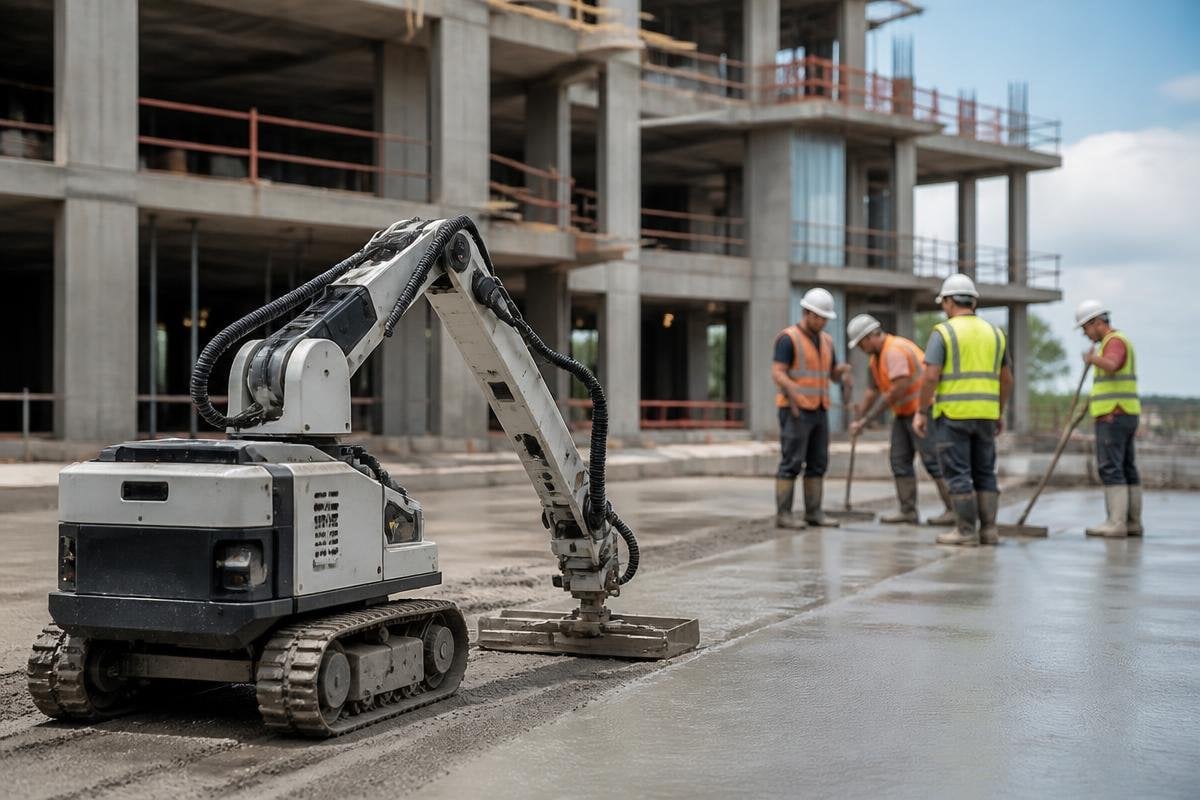
A construction robot can repeat one task for hours, but a building site still needs people to plan, inspect, repair, and adapt. Robots can reduce pressure on crews in narrow jobs; they can’t replace the full range of work behind a finished building.
Quick read
- Robots fit repeatable tasks such as bricklaying, rebar tying, layout scanning, and material movement.
- The site still needs trained people for safety checks, changes, repairs, and coordination.
- The best first step is to automate one costly task with a clear result.
Where robots fit the work
Construction has many jobs that look similar from a distance but change from one room, floor, or weather condition to the next. A robot works best when its task, path, tools, and target stay within a narrow range.
That makes layout scanning a useful example. A mobile robot can move through a site, collect LiDAR data, and compare the recorded space with a digital building plan. A crew can then find a misplaced wall or missing opening before later work covers it.
Material movement follows the same logic. An autonomous system can carry loads along a mapped route, but a person still needs to decide where the load belongs and what happens when a lift, scaffold, or delivery blocks the path.
Rebar tying, bricklaying, and surface finishing may also suit machines when the work area has a steady layout. Each task needs a different tool, motion, and safety setup. A robot built for one of them won’t automatically handle the others.
Why the labor gap remains
A labor shortage covers more than the number of hands on site. It also affects supervisors, machine operators, electricians, welders, surveyors, and people who can fix equipment when conditions change.
Robots can take over repeated motions. They don’t remove the need for someone to set up the work, check the result, manage nearby people, and respond to a fault.
Construction sites are full of small changes: a late delivery, an uneven surface, a revised drawing, or another crew working in the same space. That is where the simple replacement story breaks down.
A machine may reduce the hours spent on one task, yet the project still needs human judgment around that task. The saved labor only matters if the robot can work without creating extra setup, supervision, or repair work.
The cost is more than the robot
The company must count the full system. That includes the robot, its tool, site mapping, operator training, transport, maintenance, and the time needed to move it between jobs.
The work area matters just as much. A factory can control its floor, lighting, and parts supply. A construction site changes as walls rise and trades move through it. Dust, rain, uneven ground, and poor access can turn a repeatable motion into a new engineering problem.
Safety adds another layer. A robot sharing space with people needs clear operating limits, stop controls, inspection steps, and a person who can respond when the system behaves outside its planned path. Those duties remain part of the job even when the machine does the movement.
Those controls only matter if a robot can keep them while the site changes. Reports on construction robots can help you compare each system’s task, operator role, and stated limits before judging whether it fits a working site.
A better test for a construction robot
The useful question is not whether a robot can perform a task once. It is whether the task stays stable across enough of the project to repay the time and cost of using the machine.
I’d start with the task that has a clear output, repeated motion, and a safe place for the robot to work. A short pilot can then show whether setup time, stoppages, and human supervision leave a real saving.
Site decision checklist
Use these checks before buying or leasing a system:
- Name one task: Write down the exact work, tool, material, and finished result.
- Measure the starting point: Record crew hours, delays, rework, and setup time before automation.
- Map the site: Check floor condition, access, lighting, weather exposure, and nearby workers.
- Plan human control: Assign who starts, stops, checks, and repairs the system.
- Count the full cost: Include training, transport, software, maintenance, and downtime.
- Set a pass mark: Decide which measured result would justify another site or another task.
Construction robots can ease a labor shortage when they remove repeated work from a crew and leave people with safer, higher-skill jobs. They won’t solve the shortage alone. The next useful proof is a site where one machine completes one defined task across a full project, with the labor hours and stoppages recorded.
